Researchers Launch New Report Highlighting Indigenous Histories in Brookside Cemetery
May 14, 2026
A new University of Winnipeg study uncovers hidden Indigenous histories of Brookside Cemetery that reveal key moments in Winnipeg’s past and inform present municipal understandings of truth and reconciliation.
Brookside Cemetery is located on the western side of Winnipeg, near the Richardson International airport. In 2003 Winnipeg celebrated Brookside’s 125th anniversary and in 2023, Brookside was designated a National Historic Site, Winnipeg’s 25th such site. So far, the histories of Brookside that have been published in honour of these events have focused on recognizing and commemorating Brookside’s Veterans Field of Honour, a select group of well-known and mostly non-Indigenous Manitobans who are buried at Brookside, and the cemetery itself as one of the oldest and largest examples of the “garden cemetery tradition” in Western Canada.
Official Brookside Cemetery histories highlight its “transformation,” into a garden from, according to Parks Canada (2023), “Open prairie landscape”[1] or, as the City of Winnipeg website states, a “flat barren piece of land.”[2] These descriptions are a reminder of the ongoing role of the colonial concept of “Terra Nullius” in municipal and national historical narratives[3] and its continuing impact as it runs under the surface of narratives that imagine a City without Indigenous people or land while erasing violent and disruptive settler histories.
The Brookside Cemetery study begins with a land acknowledgement that traces the history of the land where Brookside Cemetery sits today from a rich and vibrant Indigenous space through the land loss and displacement of Indigenous people that began in the years leading up to the Rupert’s Land Transfer, and continued on during and through the Reign of Terror of the 1870s. This is a history that has, until now, gone unacknowledged.
Brookside’s Indigenous history does not end with Indigenous dislocation out of the city. The graves of Indigenous patients who passed away in Winnipeg hospitals, often far from home, and who were buried in Brookside bear witness to further Indigenous dislocation as, following World War II, the Canadian state began moving increasing numbers of Indigenous people back to the city for health care and rehabilitation.
The study’s researchers located 102 burials of Inuit and First Nations individuals who passed away at Winnipeg-area hospitals and sanatoriums and were buried at Brookside cemetery between 1950 and 1980. The report provides links to and descriptions of some of the historical records that researchers used to reconstruct this history. It also explains Department of Indian Affairs’ burial arrangement policies in effect at the time and considers how these policies impacted Indigenous people and families in Manitoba, northern and northwestern Ontario, and the Arctic.
The project had financial support from the Social Sciences and Humanities Research Council Canada; the Canada Research Chairs Program; the Canadian Institutes of Health Research; the Manitoba Sport, Culture, Heritage and Tourism Heritage Grants Program; and the University of Winnipeg Faculty of Arts, Department of History, Indigenous Summer Student Program and Research Office. Necessary research support came from the staff at Library and Archives Canada (particularly David Cuthbert) and the City of Winnipeg Municipal Cemeteries Branch, Archives, and Planning, Property & Development Branch. Authors Kathryn Boschmann, Mary Jane Logan McCallum, and Anne Lindsay are pleased to be able to make this report available for download by clicking on the link below:
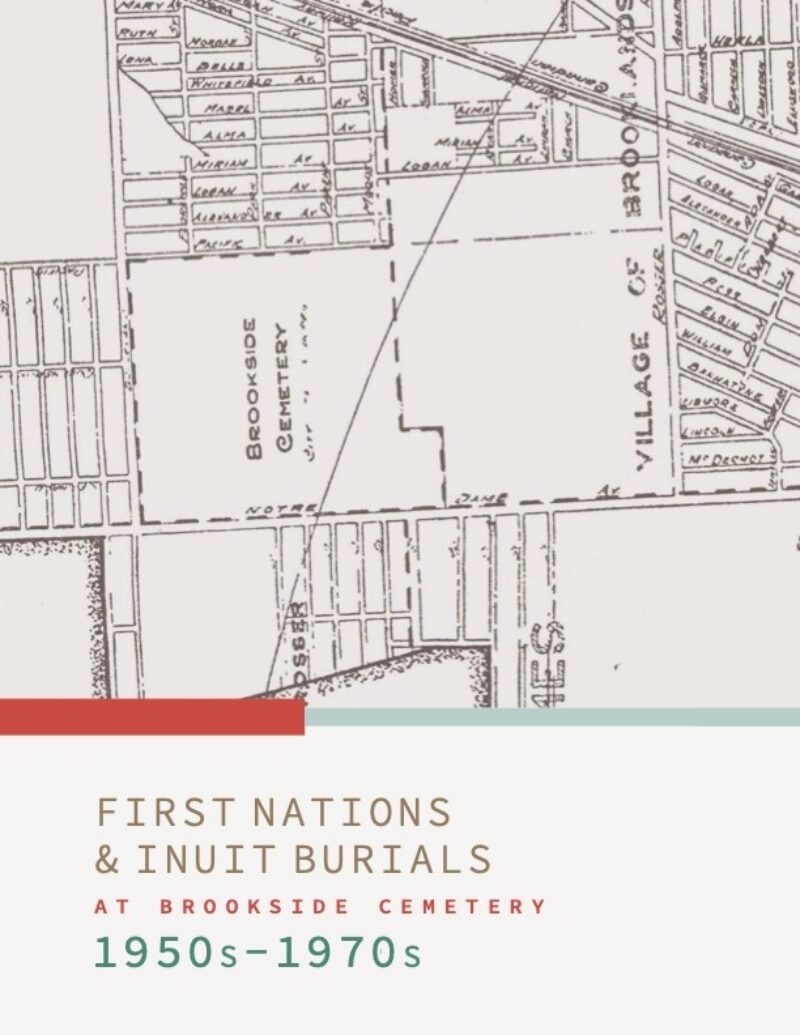
First Nations and Inuit Burials at Brookside Cemetery 1950s-1970s
__________________________________________________________________________________
[1] “Brookside Cemetery National historic Site,” on the Government of Canada Website https://parks.canada.ca/culture/designation/lieu-site/brookside. Accessed 27 Feb 2026.
[2] “Brookside Cemetery designated a National Historic Site,” 10 November 2023, City of Winnipeg Website: https://www.winnipeg.ca/people-culture/our-city-our-stories/brookside-cemetery-designated-national-historic-site#:~:text=The%20cemetery%20has%20transformed%20since %201878%2C%20when,the%20garden%20style%20cemetery%20in%20Western%20Canada. Accessed 2 March, 2026.
[3] Terra Nullius is a Latin phrase referring to “nobody’s land,” and used to justify occupying and owning lands belonging to Indigenous peoples by suggesting they are unoccupied. While the doctrine never applied in Canadian law, the concept influenced how people thought about, acted with authority over and built laws regarding Indigenous territories in Canada.